


Today I am interviewing J. Ashley-Smith, author of the new horror short story collection, The Measure of Sorrow!
◊ ◊ ◊
DJ: Hi J. Ashley-Smith! Thanks for stopping by to do this interview!
Please tell us a little about yourself for readers unfamiliar with you.
JAS: Hi, DJ. Thanks for having me.
I’m a British–Australian author of dark speculative fiction. Even though I’ve lived in Australia for coming up on 20 years, I still feel out of place, as though I stepped through a portal into some weird parallel universe. Now, even my old home, when viewed through this lens, seems unrecognisable and unfamiliar—perhaps even more so, now there’s a king on the throne! This kind of wrongness and disorientation, the sense of everyday things just out of true, is something that obsesses me. Another obsession is that inner dark from which the fantastic, the terrifying, and the impossible are born. The collision between the complexities of the modern day-to-day and the invisible or imagined world is another fixation, which I continually explore in my stories.
DJ: What is The Measure of Sorrow about?
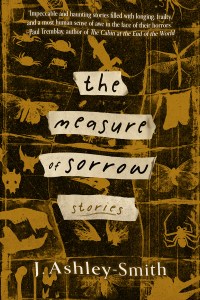
JAS: The stories in The Measure of Sorrow are united more by a feeling than a theme: I felt my way into each of them, and I felt my way through their compilation. If a theme emerges it’s as a result of instinct rather than intellect. Children feature strongly. As do parents. There’s thwarted or misguided love. There’s separation, grief and longing. People, all-too human, search for or build islands of meaning, all-too aware they are surrounded by vast oceans of coldness, indifference, or cruelty. At the cusp between these islands and the hard reality outside, there is wonder, horror, awe. People fall victim to their blind spots and weaknesses. Their search for meaning is always rewarded, but never in the way they hoped. The Measure of Sorrow centres on those perimeter moments, the border between one state or condition and another, from which something enters, something small, something strange, something unbidden and unexpected.
DJ: What were some of the inspirations behind The Measure of Sorrow?
JAS: The Australian landscape. The weirdness of dreams. Everyday lives warped by madness. Families tormented by loss. A suburb shrouded in melancholy. Fragmented glimpses of what lies beyond the veil. And, of course, sadness itself. It’s not something that’s really approved of in our culture but there’s a beauty in sadness. To live with your sorrow is to live with sensitivity, receptive to what’s really there. Sadness is an entirely appropriate response to the horrors and wonders of the human condition.
DJ: What kinds of stories can readers expect in the anthology?
JAS: The stories in the collection all have a central, inescapable darkness. They all have a certain strangeness, a certain ambiguity. There’s horror, yes, but it tends towards the quiet and weird end of the spectrum. You’ll find, I hope, a lingering sense of uncertainty, perhaps a shiver of almost-recognition as you glimpse some unknown thing from the corner of your eye.
DJ: There are many different definitions of horror in the genre, so I’m curious, when you write “horror,” how do you try to scare your readers? Do you go for gore? Shock? Maybe build up tense moments? Or perhaps it is the unknown?
JAS: For me, writing dark fiction is a means to explore, and perhaps purge, my own fears. Through the lens of fear and anxiety, the world can seem a hostile, brutal place; an unforgiving place filled with suffering and anguish. While the world may be filled with frightening things, perhaps the most terrible of all is the feeling there’s no point to anything—that the universe is vast and uncaring and completely uninterested in us, in our joys, in our suffering. To be human is to create an island of warmth, of kindness, protection from the shadows and the cold. In the absence of meaning, we create meaning for ourselves and for those around us. And this struggle obsesses me. This mix of courage and frailty, and the sense of awe—of wonder, even which is the only appropriate response in the face of that nameless vastness.
DJ: Being an author, what do you believe makes a good short story? How does it
differ from writing novel-length stories?
JAS: A good short story is like a photograph. It’s a slice, just a single frame. And yet everything you need to know to enjoy and understand it is within its borders. There’s a whole living world beyond its edges, the sense of a narrative that existed before you picked up the story and that will persist long after you put it down. You’re granted this glimpse, this snapshot, which is entirely self-contained, but hints at something too large to be captured in a single image or a few thousand words.
How does it differ to a novel? It’s easier to finish!
DJ: This may… this will be a difficult question to answer, but what are some of your favorite stories in The Measure of Sorrow? I don’t mean what you believe is the best – but perhaps some stories have a particular setting, theme, message, or character that stood out to you?
JAS: That’s like asking which of my children I love the most! All of them give form to whatever obsession was consuming me at the time I wrote them, and all left their scars in one way or another. But I suppose if I had to pick one, it would be the title novella. That story was a labour of love I started almost ten years ago and promptly trunked as unfinishable. In the time since, I’ve drawn it out again and again, desperate to breathe life into its beautiful imperfect corpse. And again and again I’ve shoved it back in its trunk, convinced it would never be complete and would never see the light of day. It was beyond exhilarating when that story came to vivid life, brought suddenly into focus by its new title. It’s the black sun around which all the other stories revolve.
DJ: What was your favorite part about writing The Measure of Sorrow?
JAS: I love the total immersion that comes from writing fiction of any kind. The act of writing is a communion with the imagination, a delicate thread of words, placed one in front of the other, that connects you with something deeper than yourself. The stories in the collection were written over a long period—ten total immersions over almost as many years—so it’s hard to pick with any certainty a favourite moment from across that time. There was a point, though, when I was putting the finishing touches on the collection, the final pass of edits before it went back to the publisher for layout. I’d been anxious that it didn’t really hang together, was just a random mish-mash of stories that made no sense. I worried I was making a big mistake. I read it through from beginning to end—perhaps the first time I’d done that with such close attention—and felt a satisfying click inside myself. I knew it wasn’t perfect, but it was exactly what I had hoped for and what I wanted it to be.
DJ: What do you think readers will most discuss once they finish it?
JAS: The abominably unfair ending.
DJ: When I read, I love to collect quotes – whether it be because they’re funny, foodie, or have a personal meaning to me. Do you have any favorite quotes from The Measure of Sorrow that you can share with us?
JAS: There is a line I return to again and again with a sense of amazement. It comes from the second story, Old Growth, about a man struggling to connect with his estranged children. Scott is an environmental scientist with a passion for trees. At the same time, he’s a husk, hollowed out by grief. Early in the story, he’s having a conversation with his son about epicormic growth on nearby eucalyptus trees. “Isn’t it amazing?” he says. “This mechanism they’ve adapted for survival. They can be dead inside and still go on living.” At the time I wrote it, I was writing about the trees. But that last line perfectly sums up the character, and the heart of the story. Scott was talking about himself.
DJ: Now that The Measure of Sorrow is released, what is next for you?
JAS: Writing more stories. Immersing myself again and again in the dark waters
of the imagination.
DJ: Where can readers find out more about you?
Website: https://www.spooktapes.net/Author Newsletter: https://spooktapes.substack.com/
Instagram: https://www.instagram.com/spooktapes/
Facebook: https://www.facebook.com/profile.php?id=100009103403134
Twitter: https://twitter.com/SpookTapes
Goodreads: https://www.goodreads.com/author/show/14291524.J_Ashley_Smith
Amazon Author Page: https://www.amazon.com/stores/J.-Ashley-
Smith/author/B07RMX4Q3P?ref=ap_rdr&store_ref=ap_rdr&isDramIntegrated=tru
e&shoppingPortalEnabled=true
DJ: Before we go, what is that one thing you’d like readers to know about The Measure of Sorrow that we haven’t discussed yet?
JAS: That if you like a dose of humanity with your horror; if you’re a lover of the weird, the unsettling, the unusual, the eerie, the ambiguous; if you want to read stories with heart and darkness; then I’d love you to check out The Measure of Sorrow.
DJ: Thank you so much for taking time out of your day to answer my questions!
JAS: My pleasure. Thanks for having me.
◊ ◊ ◊
***The Measure of Sorrow is published by Meerkat Press and is available TODAY!!!***
Buy the Book:
Amazon | Bookshop.org | Meerkat Press
◊ ◊ ◊

About the Book:
Shirley Jackson Award-winning author J. Ashley-Smith’s first collection, The Measure of Sorrow, draws together ten new and previously acclaimed stories of dark speculative fiction. In these pages a black reef holds the secret to an interminable coastal limbo; a father struggles to relate to his estranged children in a post-bushfire wilderness; an artist records her last days in conversation with her unborn child; a brother and sister are abandoned to the manifestations of their uncle’s insanity; a suburban neighborhood succumbs to an indescribable malaise; teenage ravers fall in with an eldritch crowd; a sensitive New Age guy commits a terminal act of passive-aggression; a plane crash opens the door to the Garden of Eden; the new boy in the village falls victim to a fatal ruse; and a husband’s unexpressed grief is embodied in the shadows of a crumbling country barn. Intelligent and emotionally complex, the stories in The Measure of Sorrow elude easy classification, lifting the veil on the wonder and horror of a world just out of true.
About the Author:
J. Ashley Smith is a British–Australian author of dark fiction and co-host of the Let The Cat In podcast. His first book, The Attic Tragedy, won the Shirley Jackson Award. Other stories have won the Ditmar Australian Shadows and Aurealis awards. He lives with his wife and two sons beneath an ominous mountain in the suburbs of North Canberra, gathering moth dust, tormented by the desolation of telegraph wires. You can find him at spooktapes.net, performing amazing experiments in electronic communication with the dead. His debut collection, The Measure of Sorrow, is out now from Meerkat Press.
 Bookworm M.D.
One thought on “Author Interview: J. Ashley-Smith”